
The waterjet cutting unit within Hom Makina combines the power of high-pressure water flow with modern manufacturing technologies to deliver precise, clean, and reliable cutting across a wide range of materials. Our high-efficiency system provides fast production and a solution-oriented approach based on customer requirements. Thanks to its advanced control structure and high-pressure waterjet technology, our cutting unit operates with minimal tolerance even on complex geometries.
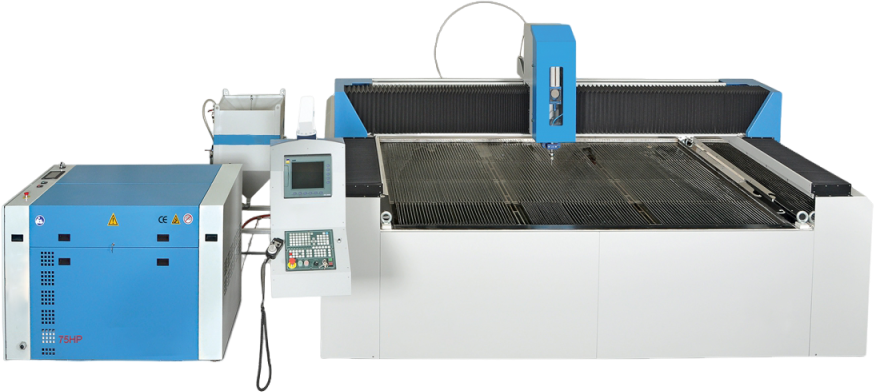
Technical Specifications
- Pressure Capacity: Thanks to its high-pressure operating structure capable of reaching up to 4,000 bar, the waterjet pump ensures stable and clean cutting even on hard materials such as metal, plastic, glass, and composites.
- Cutting Method: While a garnet abrasive reinforced cutting method is used for hard and dense materials, pure water cutting is preferred for softer materials. This ensures the most efficient method is selected for each project in terms of both speed and quality.
- Material Thickness: The waterjet system can operate across a wide thickness range by adapting to different material densities. Even as thickness increases, cutting quality is maintained to achieve smooth edge surfaces.
- Cutting Precision: Thanks to its CNC-controlled motion system and robust mechanical frame structure, precision cutting can be achieved down to ±0.1 mm. This accuracy provides high precision for prototype production, custom-dimension parts, and engineering-demanding applications.
- Working Area: Our cutting unit features a large cutting table capable of processing both large-sized sheets and plates as well as small parts. This makes the cutting process more flexible and enables the production of large parts in a single run.
- Control System: The 3-axis CNC structure precisely manages all movements of the cutting head. Thanks to CAD/CAM compatibility, drawings can be processed directly, and even complex-shaped parts can be cut accurately.
Frequently Asked Questions
Waterjet cutting technology is preferred across many industries thanks to its wide material compatibility. Metals (steel, stainless steel, aluminum, copper, brass), plastics, glass, ceramics, rubber, composite surfaces, and many other industrial materials can be cut with high precision using waterjet cutting. Since no heat is used, safe cutting is achieved even on materials with a high risk of cracking, such as glass, ceramics, and composites. In addition, edge deformation does not occur on flexible materials like rubber and plastic.
No, waterjet cutting is a completely cold cutting method. No thermal load is transferred to the material during the process, which means none of the issues seen in traditional thermal cutting methods such as burning, hardening, melting, discoloration, or structural distortion occur. Especially for applications requiring tight tolerances, the absence of heat effect preserves part integrity and minimizes the need for secondary processing. This results in extremely clean, smooth, and dimensionally stable surfaces. Even for metal types that can lose properties due to heat, a safe and high-quality result is achieved.
Yes, one of the biggest advantages of waterjet cutting is that it is a production method that does not require molds. For this reason, it is an economical and fast solution for all types of work, from single-piece prototype cutting to low-volume custom production. Since it does not require molds, blades, or special tooling preparation, incoming projects can be taken into production directly from CAD files. This both reduces costs and significantly shortens production time. For one-off custom jobs, rapid sample work, and the production of personalized parts, waterjet cutting is an extremely ideal method.
In waterjet cutting, tolerance varies depending on the machine quality and the type of material being processed, but in advanced CNC-controlled systems it can generally reach up to ±0.1 mm. This precision provides a major advantage especially in the production of parts with complex geometries, engineering projects, and applications that require assembly. In addition, thanks to the clean cut surface, the cut parts can often move to assembly or the next production step without requiring additional processing. High precision makes waterjet cutting a more reliable option than laser or plasma in many applications.
Yes, a CAD file is very important in waterjet cutting operations to achieve the most efficient and accurate results. Drawings in formats such as DXF, DWG, or similar can be processed directly by the cutting program, enabling error-free, fast, and dimensionally accurate production. Production can also be carried out based on drawings created without CAD files; however, the process takes longer and may require additional revisions.
Waterjet cutting pricing is generally determined by a combination of several factors. The type and thickness of the material to be cut, the geometric complexity of the part, the total cutting length, and the production quantity directly affect the cost. Complex and highly detailed parts may require longer machine time on the CNC system, increasing the overall processing time. Likewise, the amount of abrasive used and the material type are also among the factors that influence pricing. Based on the CAD files received from our customers, the cutting path is calculated and a clear, accurate quotation is provided.
Waterjet cutting is a technology that provides clean and smooth surface quality. For this reason, in many applications, parts have edges smooth enough to be used immediately after cutting. Since there is no heat effect, issues such as burning, darkening, melting, burring, or structural deformation do not occur. In some dense or very thick materials, slight surface roughness may be observed; in such cases, a simple grinding or sanding process is sufficient.
Waterjet cutting is a widely used technology across many industries thanks to its versatile structure and broad material compatibility. In the machinery manufacturing sector, it enables the precise production of metal plates, custom parts, and prototypes. In the automotive field, it is preferred for clean and dimensionally accurate cutting of gaskets, plastic parts, and metal fasteners. In the defense industry, it is a reliable method for producing metal and composite parts that require tight tolerances. In architecture and decoration projects, it allows smooth lines on marble, granite, glass, and custom-designed surfaces. In the advertising and signage sector, it is frequently used for shaping composite, plexiglass, and aluminum panels. It also finds safe application in the food and packaging industry thanks to the hygiene advantage of pure water cutting.