
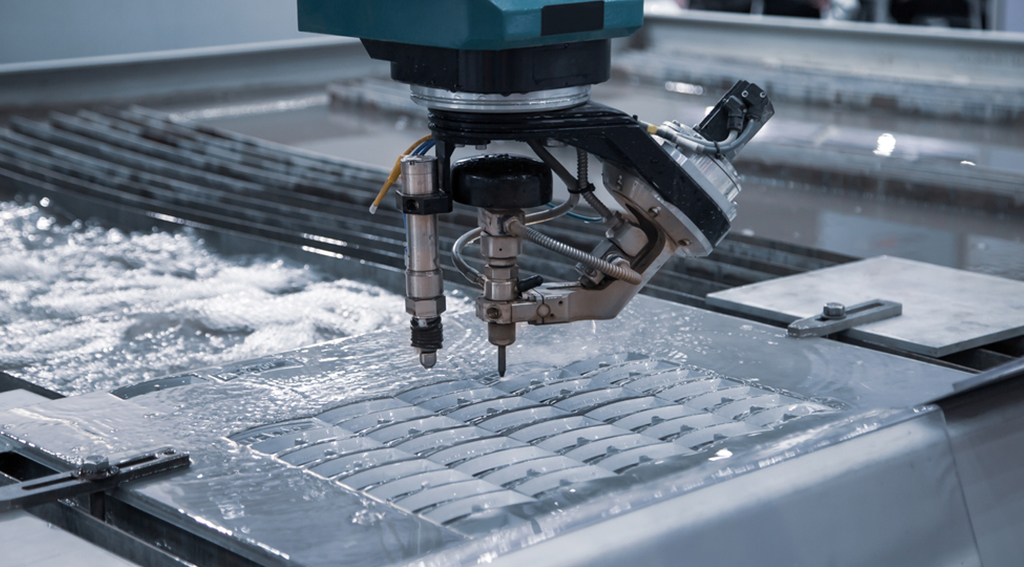
Understanding the differences between waterjet cutting and laser cutting is the first step in choosing the most suitable cutting method for your production needs. Although both technologies are widely used in industry, they differ significantly in working principles, material behavior, and the resulting surface quality. Waterjet cutting is based on performing the cutting process by combining high-pressure water with abrasive materials, and it is a completely cold method.
For this reason, it does not create unwanted effects such as deformation, burn marks, or hardening on a wide range of materials including metal, stone, ceramics, composites, and rubber. Laser cutting, on the other hand, cuts by melting or burning the material surface with a concentrated beam and delivers fast results especially on thin sheets.
One of the key points manufacturers focus on when deciding is surface quality and tolerance. Waterjet cutting produces much smoother, burr-free edges than laser cutting, especially on thick materials. It also provides higher precision in projects with complex internal contours and tight turns. Laser cutting is often preferred on mass production lines due to its speed advantage; however, this speed can become a disadvantage when the material is heat-sensitive. In particular, heat-related deformations are commonly seen in laser cutting for stainless steel and tight-tolerance parts.
When evaluating cost, the material type and thickness are decisive. Laser cutting can be economical for thin sheets, while waterjet cutting becomes a more efficient option for thicker parts. In addition, since waterjet technology does not require molds, it offers great convenience for prototyping and custom production work. When all these factors are considered together, the choice between waterjet cutting and laser cutting is shaped by criteria such as production volume, tolerance expectations, material properties, and surface quality. Therefore, a detailed technical analysis of the needs is crucial to determine the right method.